What Aerial Dance Taught Me about Control, Letting Go, and Learning to Soar
Author’s Note (Revisited)
This was originally written in 2013.
Reading it now, over a decade later, I can see something I didn’t have language for at the time. What I thought was a reflection on aerial dance was actually the beginning of something much larger—something that would eventually shape my clinical work, my philosophy, and what I now call Fire Reclamation.
Back then, I was learning how to manage myself.
Now, I help women learn how to lead their lives.
And somewhere in between—there was a suspended hoop, two strands of fabric, and a moment where I stopped trying to control everything.
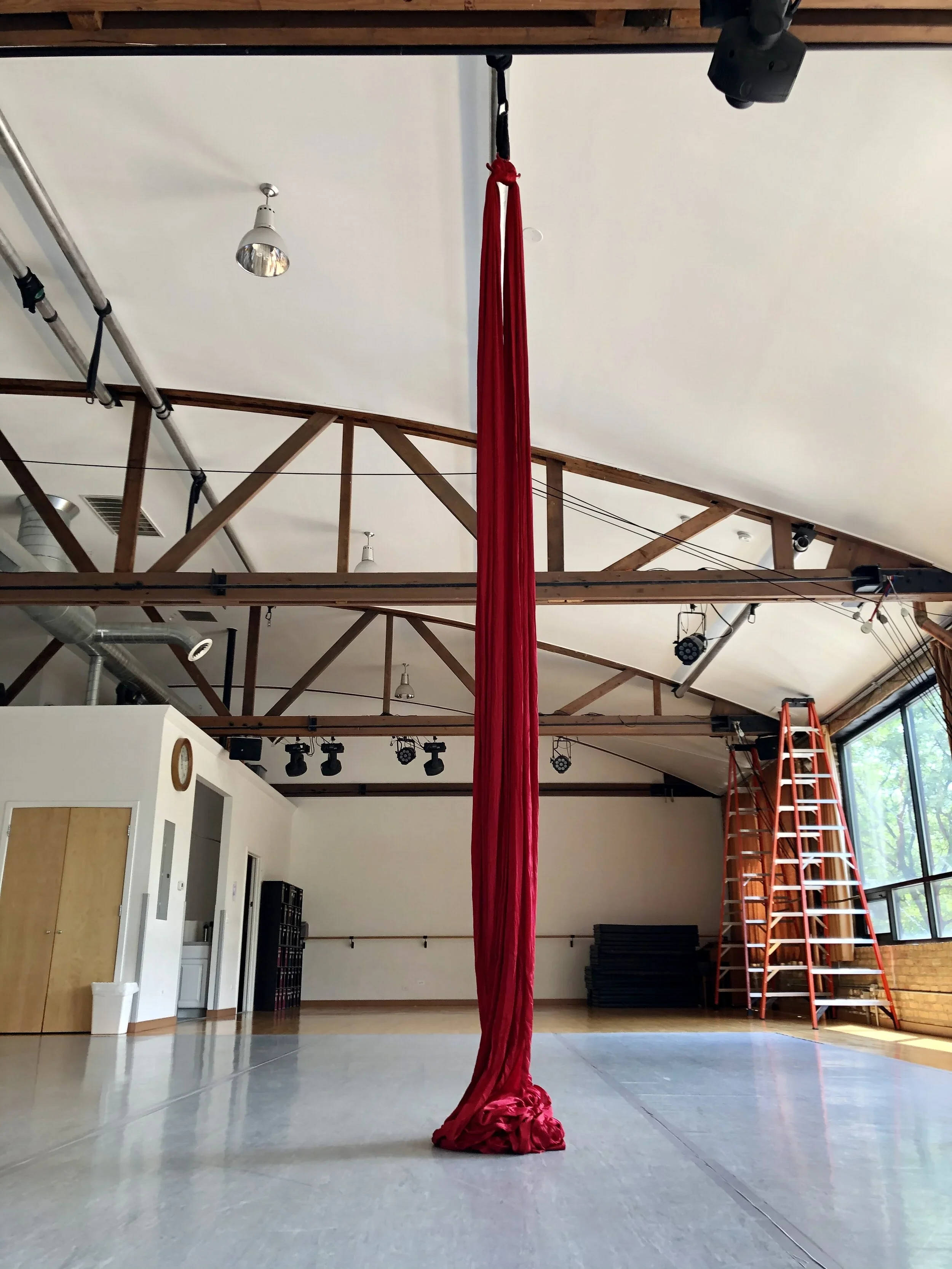
At Aerial Dance Chicago—learning to be in the air before I knew how to be inside uncertainty.
In 2013, I started learning the art of aerial dance.
The classes had been a Christmas gift from my fiancé, and at the time, I was simply excited to try something new. What I didn’t fully realize was how much I needed it.
Just a few months earlier, my father had fallen 30 feet from scaffolding. The accident left him paralyzed from the waist down, with minimal upper body movement. Life, in a very real and irreversible way, had shifted.
And while I was trying to hold everything together—emotionally, mentally, practically—life had already made something very clear:
I was not in control.
There was an irony I couldn’t ignore. While my family was navigating the aftermath of a devastating fall, I was about to intentionally take to the air.
In aerial dance, you work with an apparatus.
For me, it was the lyra—a suspended hoop—and fabric, two long silks flowing from the ceiling. Both required strength, precision, and a willingness to leave the ground in a very literal sense. I learned climbs, locks, balances, transitions—how to move in a space where gravity was no longer something you could take for granted.
But what stayed with me wasn’t the technical skill.
It was something else.
Something I didn’t recognize at the time.
The apparatus doesn’t behave the same way twice.
You can perform the exact same movement, in the exact same sequence, and still get a completely different experience. It might spin more. It might shift. It might not respond the way you expect.
At first, this drove me crazy.
I wanted to perfect it. I wanted consistency. I wanted to be able to do something “right” and have it stay right.
But the more I tried to control the apparatus, the more frustrated I became. The harder I pushed, the more it resisted. It felt unpredictable, uncooperative—almost personal.
At some point, my instructor said something that, at the time, felt simple. In hindsight, it was anything but.
“Dance with the apparatus as if you were dancing with a partner.”
Something in me softened when I heard that.
Instead of fighting it, I began to move with it. Instead of trying to force it into submission, I approached it with curiosity—as if I were interacting with something alive, something responsive, something that required attention rather than control.
And almost immediately, something shifted.
The less I tried to control, the more freedom I felt.
The more I trusted, the more options became available to me.
The movements didn’t become easier, exactly—but they became more fluid. Less rigid. Less strained. I wasn’t bracing in the same way.
For the first time in a long time, I wasn’t trying to get it right.
I was participating.
And I was a little obsessed.
For the next several years, I took every class I could fit into an already packed schedule—something in me knew I had found more than just a hobby.
I didn’t have language for it back then.
I just knew something felt different.

Less control. More movement.
At the time, I understood this through the lens of radical acceptance. And that was true, to a point. I was learning how to accept what was happening instead of fighting against it.
But looking back now, I can see that something deeper was happening.
This wasn’t just about acceptance.
It was about learning how to work with reality instead of against it.
Not collapsing. Not giving up. Not resigning.
But letting go of the idea that control was the thing keeping me safe.
This is where I now see the early roots of what I call Fire Reclamation.
Not becoming someone new.
But becoming someone who is no longer willing to organize her life around fear, overcontrol, or the constant effort to get everything exactly right.
Because what I see now—both in my own life and in the women I work with—is that many of us were taught, very early on, how to manage ourselves.
Our reactions. Our emotions. Our tone. Our needs.
We became skilled at monitoring, adjusting, anticipating.
But we were not necessarily taught how to lead our lives.
And so control becomes the strategy.
If I can just get it right…
If I can just stay ahead of it…
If I can just prevent the wrong thing from happening…
Then maybe I’ll feel okay.
But control has a cost.
And eventually, something starts to push back.
What aerial dance taught me—long before I had the clinical language for it—was that freedom doesn’t come from controlling every variable.
It comes from building trust in your ability to respond.
To stay present inside something uncertain.
To move without having everything figured out.
To tolerate the moment where it doesn’t feel resolved—and continue anyway.
This is the same shift I now help clients make every day.
Especially in OCD and anxiety work, where the pull is always toward certainty. Toward solving, figuring out, locking things down so they feel safe.
And the work becomes something very different.
Learning how to stay.
Without solving.
Without fixing.
Without controlling.
And still move forward.
That’s the work we do in OCD and anxiety therapy intensives. And it’s the heart of Fire Reclamation work as well.
Not just managing symptoms.
But changing your relationship with uncertainty, with control, and ultimately—with yourself.
I didn’t know it at the time, standing in that studio, suspended in the air.
But that moment—where I stopped trying to force the experience and started moving with it—was the beginning of something much larger.
Not learning how to get it right.
But learning how to trust myself inside what I couldn’t control.
And that changed everything.